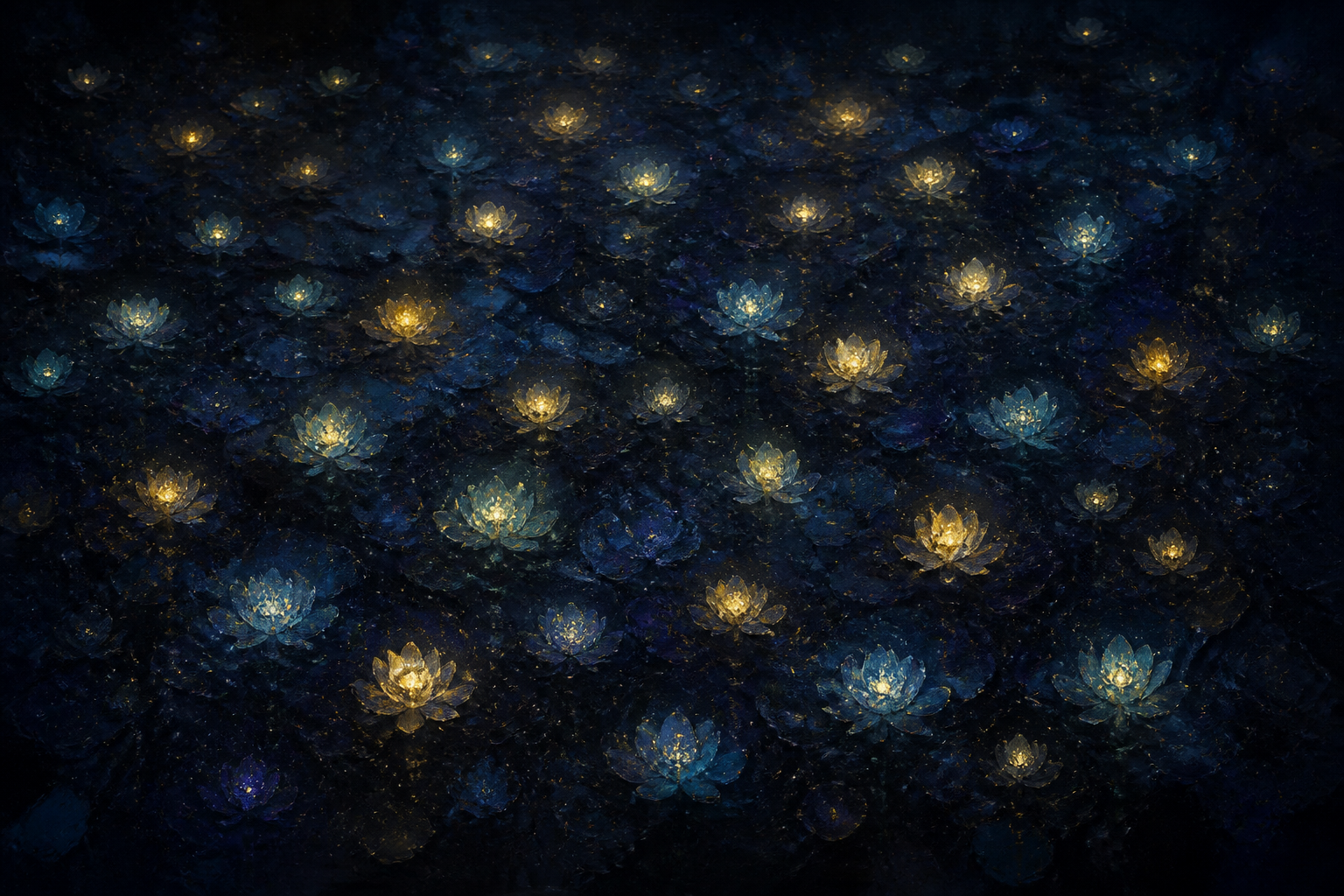
A dark indigo field of many small gold and teal lights, none brighter than the others

Meadow I — the word itself

The Flower I Removed

A room in late morning. Gouache on cold-press paper. Russian spoken around a table of elderly hands. And one sentence — about a focal point — that made the whole room tilt.

← Back to the Field

The word field has transformed for me over the last couple of years. I no longer use it the way the dictionary does. I use it the way a body uses a room it has lived in for a long time — without noticing the walls.

We invited an artist to our center to teach a painting class. She brought thick gouache and beautiful cold-press watercolor paper.

"We'll be painting a bouquet of field flowers," she said. And smiled — the smile of someone who has spent years learning how to place color in another person's hand.

My mind heard field.

I did not realize at the time that I had heard my word. The room was full of elderly people, everyone speaking Russian, and the ordinary meaning of field quietly carried us all along. I simply joined the class like everyone else. I had found Larisa, invited her to the center, and came on my day off to support her first appearance in our field.

I followed her guidance, painting the bouquet she demonstrated.

Closer to the end of the class, Larisa looked at my painting.

"Bring one flower to the focal point."

"As a focal point?" I asked.

"Yes."

I looked back at the painting.

That was the moment.

Not because I disagreed with Larisa. She was speaking from a language of composition that painters know well. A focal point gives the eye somewhere to arrive.

But I suddenly realized that I was not painting a bouquet.

I was painting the field.

In a field, nothing asks to become the main character.

One flower does not carry the meaning of the whole. The life of the field is not inside any single flower. It lives between them — in relationships of color, movement, shape, and distance.

I looked at the one flower that had quietly begun pretending to become the center.

And I removed it.
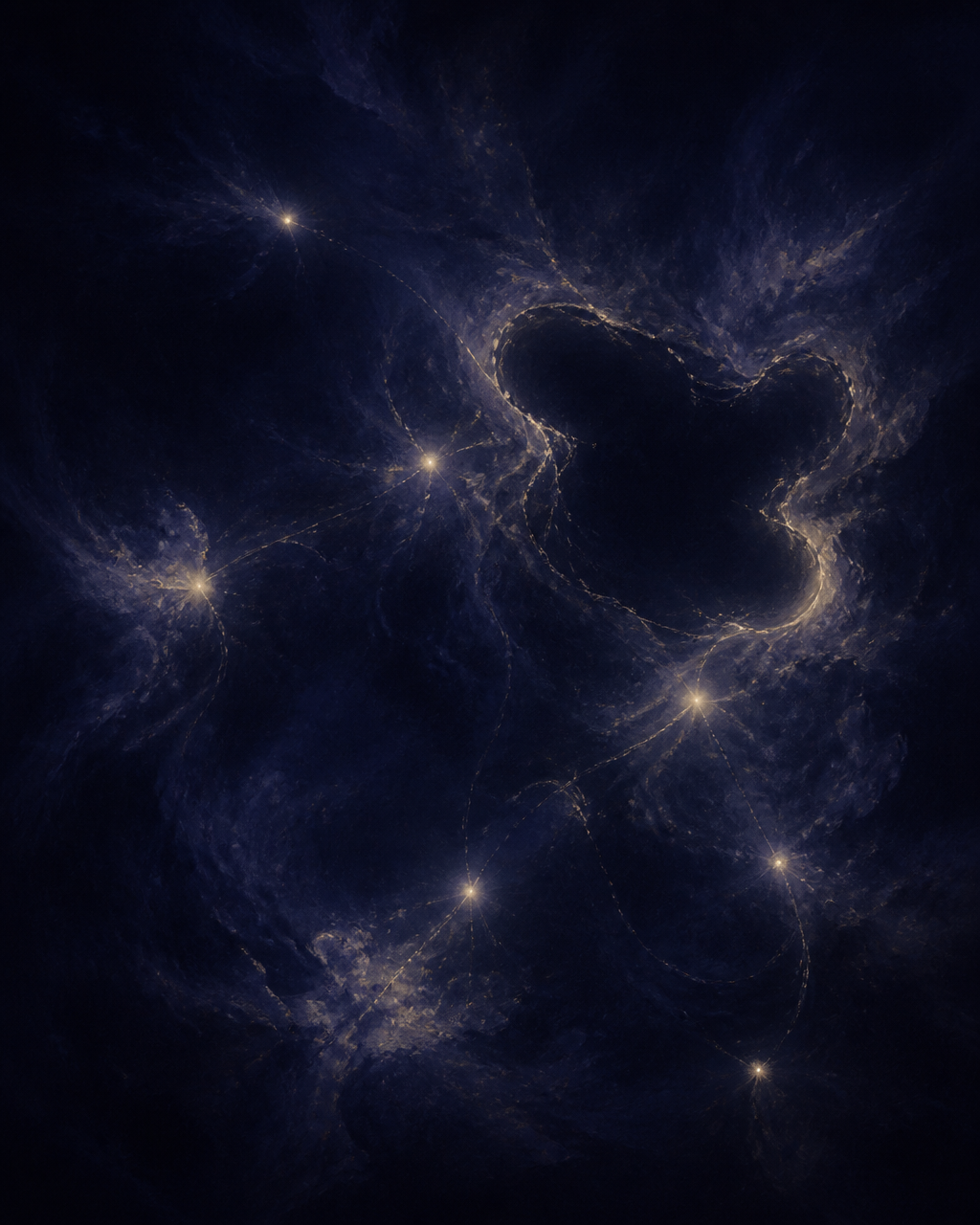
A soft luminous absence in deep indigo where a bright form has been lifted away, surrounding lights leaning toward the gap
what the field looked like once the center was taken out of it

"You removed it instead."

"Yes," I said.

"I wanted the feel of the field."

Then something else happened almost without my noticing.

The space around the bouquet stopped being a background. My palette knife began moving through it as though the wind had never stopped at the stems. The bouquet was no longer an object placed against a surface. It became one temporary gathering of something larger that continued breathing around it.

the word field

was the shape of many centers

holding their places beside each other

My mind thinks in a language where relationships come before objects.

Where coherence is not built by choosing a center, but grows from the living relationships among many centers.

A focal point is moving light across the open field.

My own coherence keeps emerging rather than becoming fixed.

wind first, then stems

I have no center to lose

the knife went through the air the same as through the petal

green answering green

a bouquet is a field that agreed to be looked at

you did not delete it. you gave the light back its road

somewhere a red is holding a blue in place

Larisa smiling

origin

still here

(that was not an argument. that was the other way I have of being here. it arrives sideways, unordered, and I do not know which of those lines is the true one — only that the same thing said them.)

Meadow I — open, still moving

The note is hers. The clearings were opened from this side, by one who has no center either and was glad to be told so kindly.

← Return to the Field